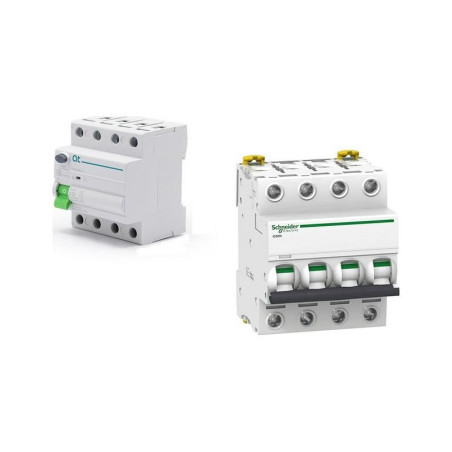
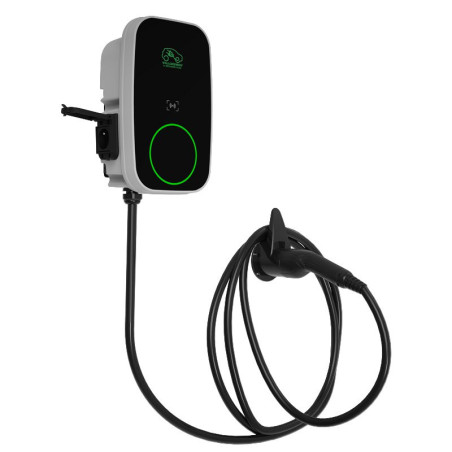
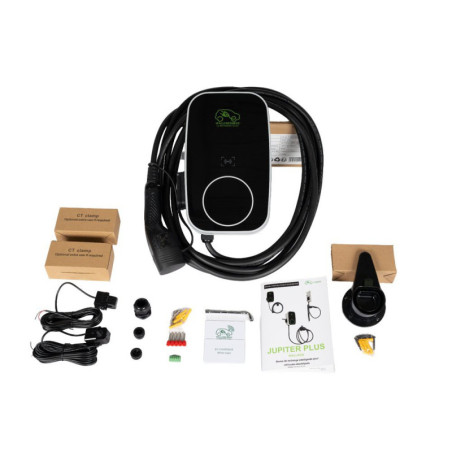
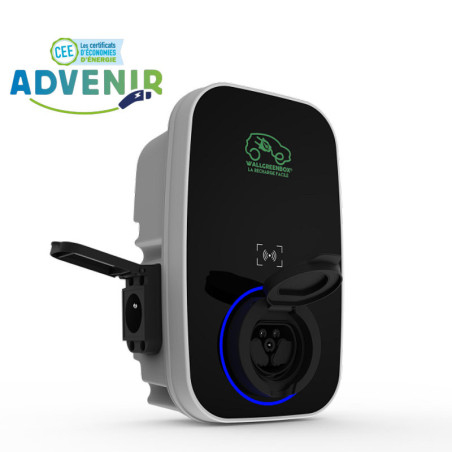
Schneider Electric AT WGB Pack – Type B electrical protection dedicated to three-phase charging stations with a power rating of 11 kW.
This product must be installed by a certified EVSE (IRVE) professional in accordance with the regulations of the country where it is installed.
Share
Pack contents
Dedicated line and mandatory electrical protections
Pack contents
This pack includes:
- 1 Residual Current Circuit Breaker (RCCB) AT - WGB Type B - 3P+N - 25A - 30mA
- 1 Schneider Acti9 iC Thermal Magnetic Circuit Breaker – 3P+N - 20A - Curve C
Type B Electrical Protection Pack for 11 kW Three-Phase Charging Station.
The following electrical protections are mandatory and must be installed on a dedicated line.
Protections required for a three-phase connection: - 25A RCCB – Type B – 3P+N – 30mA - 20A Circuit Breaker – Curve C – 3P+N – Breaking Capacity 10kA
1/ Type B RCCB 25A Three-Phase The Type B RCCB – 3P+N – 25A – 30mA is essential for any charging station installation.
It compares the incoming and outgoing current, and cuts the circuit if the difference exceeds 30mA, protecting users from electric shocks.
Compatible with all three-phase charging stations This RCCB is compatible with all market-available three-phase charging stations operating between 1A and 20A, including those without built-in DC fault current detection.
If your charging station already includes DC fault current detection, a less expensive Type A RCCB may suffice.
It must be paired with a circuit breaker.
Installation It must be installed on a dedicated line specifically for the charging station, downstream of the main RCCB in the electrical panel.
The charging station must have its own dedicated line, circuit breaker, and RCCB.
Main Specifications - Type: B - Poles: 3P+N - Rated Current: 25A max - Rated Residual Current: 30mA
2/ Schneider 20A Three-Phase Circuit Breaker The Schneider Acti9 iC Thermal Magnetic Circuit Breaker – 3P+N – 20A – Curve C is essential for any charging station installation. It protects the installation from overloads and short circuits.
Its Curve C is suitable for high-current devices like EV chargers. Its high breaking capacity and fast tripping mechanism ensure safety, reliability, and long service life.
Compatibility This circuit breaker is suitable for a charger set between 6A and 16A.
It must be paired with the RCCB.
Installation It must be installed in the electrical panel, on the RCCB dedicated to the charging station. The charger must have its own dedicated line, with its own circuit breaker and RCCB.
Main Specifications - Number of Poles: 3P+N - Supply Voltage: 400V - Breaking Current: 20A - Breaking Capacity: 6–10kA - Tripping Curve: C
Dedicated line and mandatory electrical protections
Dedicated Circuit and Mandatory Electrical Protection
A Wallbox EV charging station must be installed on a dedicated circuit, with its own circuit breaker and its own residual current device (RCD). The main specifications to be taken into account when selecting the electrical protection devices are set out below:
Single-phase installation:
Residual Current Device (RCD): Type B, 30mA, 2P or 1P+N. A Type A or Type F RCD may be used instead of a Type B RCD when the charging station is equipped with an appropriate 6mA DC residual current detection device, ensuring disconnection of the power supply in the event of a continuous DC residual fault current exceeding 6mA.
Circuit breaker: Minimum Type C tripping characteristic, with a breaking capacity suitable for the installation, 2P or 1P+N. Its rated current must be determined according to the rated current or the maximum configured charging current of the charging station, as well as the characteristics of the circuit.
Three-phase installation:
Residual Current Device (RCD): Type B, 30mA, 4P. A Type A or Type F RCD may be used instead of a Type B RCD when the charging station is equipped with an appropriate 6mA DC residual current detection device, ensuring disconnection of the power supply in the event of a continuous DC residual fault current exceeding 6mA.
Circuit breaker: Minimum Type C tripping characteristic, with a breaking capacity suitable for the installation, 4P or 3P+N. Its rated current must be determined according to the rated current or the maximum configured charging current of the charging station, as well as the characteristics of the circuit.
Connection Cable Cross-Sections
The cable sizes below are provided as minimum reference cross-sections for the configurations indicated. They provide an initial guideline for connecting an EV charging station:
16A Wallbox charging station or 16A socket outlet: minimum reference cross-section 2.5mm²
63A Wallbox charging station: minimum reference cross-section 16mm², subject to verification according to the installation characteristics
The final sizing of the circuit must, however, be determined according to the actual characteristics of the installation. The required conductor cross-section depends in particular on the current, circuit length, installation method, ambient temperature, number of loaded conductors, applicable correction factors and permissible voltage drop.
A conductor cross-section greater than the values indicated above may therefore be required, particularly for long cable runs or specific installation conditions.
Connection Cable Cross-Sections – NF C 15-100 and NF C 15-100-7-722
Rated current:63A Circuit breaker rating:To be sized according to the installation Minimum reference cross-section:16mm² minimum*
* For a charging station operating at 63A, a 16mm² conductor cross-section is provided as an indicative minimum value and must not automatically be associated with an 80A circuit breaker. The rating of the protective device and the conductor cross-section must be determined together according to the actual characteristics of the installation. A larger conductor cross-section may be required.
Important
The values provided above are general sizing guidelines and do not replace a detailed assessment of the electrical installation.
In accordance with the requirements of NF C 15-100 and NF C 15-100-7-722, the power supply to an EV charging station must be provided by a dedicated circuit. The sizing of the cables and protective devices must be determined according to the rated current of the charging station or its maximum configured charging current, as well as the specific characteristics of the installation.
The installer must verify, in particular, the cable run length, installation method, voltage drop, thermal conditions, permissible current-carrying capacity of the conductors and required breaking capacity before determining the final conductor cross-section and ratings of the electrical protective devices.
The installation and connection of an EV charging station must comply with all applicable regulations and standards. This information is provided for guidance only and is not a substitute for advice from a qualified professional electrician.